English
 Italian
Grapefruit and furanocoumarins: why choosing a controlled extract truly changes the safety profile
Pink grapefruit is one of the most interesting citrus fruits in the modern nutraceutical landscape. Naturally rich in bioflavonoids and phenolic compounds, it is used in numerous formulations designed to support antioxidant wellness, microcirculation, and cellular protection.
In recent years, however, scientific and formulation-focused attention has increasingly concentrated on a specific aspect of the citrus matrix: the presence of furanocoumarins.
These compounds, naturally present in grapefruit, are now considered a fundamental quality parameter in the evaluation of a botanical extract. For this reason, the most advanced manufacturers are directing research toward highly standardized ingredients capable of maintaining high concentrations of functional substances while minimizing unwanted components.
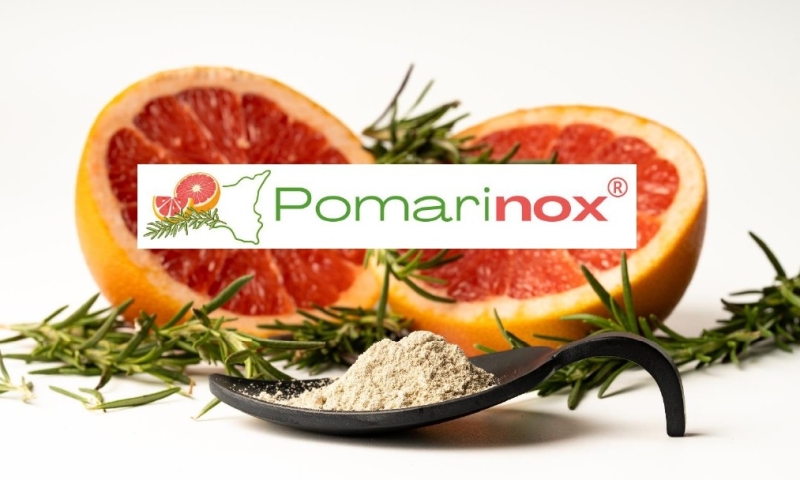
It is within this context that Pomarinox® was developed, an innovative dry extract obtained from pink grapefruit and rosemary, standardized to 50% bioflavonoids and 1% rosmarinic acid, with a furanocoumarin content below 10 ppm.
What Are Furanocoumarins and Why Are They Important
Furanocoumarins are secondary metabolites naturally present in several plant species, particularly in citrus fruits belonging to the Rutaceae family. In grapefruit, the main identified furanocoumarins are:
• bergamottin;
• epoxybergamottin;
• 6’,7’-dihydroxybergamottin.
The scientific review “Chemistry and health effects of furanocoumarins in grapefruit” describes in depth the chemistry, biosynthesis, and biological effects of these molecules, highlighting grapefruit as one of the main dietary sources of furanocoumarins in the Western diet¹.
An interesting element emerging from the literature is the difference between the main grapefruit varieties: yellow grapefruit generally tends to contain higher levels of furanocoumarins, while pink grapefruit is on average richer in bioflavonoids. This distinction helps explain why, in formulation applications, pink grapefruit is often preferred when seeking a balance between functional activity and better control of the phytochemical profile.
The study also emphasizes that furanocoumarin content can vary significantly depending on botanical variety, environmental conditions, storage temperature, processing techniques, and extraction methods.
This means that not all grapefruit extracts share the same qualitative profile, and that controlling these substances is now one of the most important aspects in the development of advanced nutraceutical ingredients.
Scientific Research Confirms the Role of Furanocoumarins in Metabolic Interactions
The scientific community’s interest in furanocoumarins mainly stems from their ability to interfere with key enzymatic systems involved in the metabolism of xenobiotics and numerous pharmacologically active compounds. The most extensively studied mechanism concerns the inhibition of cytochrome P450 3A4 (CYP3A4), an enzyme highly expressed at both intestinal and hepatic levels and responsible for the biotransformation of a wide range of substances.
When CYP3A4 activity is modulated by the furanocoumarins present in grapefruit, significant changes in the bioavailability of certain drugs may occur. This phenomenon has made grapefruit one of the best-known examples of food–drug interaction in pharmacological research.
Over the years, several scientific studies have investigated this mechanism, progressively clarifying the specific role of furanocoumarins.
Among these, one particularly relevant study compared conventional grapefruit juice with a furanocoumarin-free version, evaluating its effect on the pharmacokinetics of felodipine, a calcium channel blocker extensively metabolized by CYP3A4. The results demonstrated that removing furanocoumarins significantly reduced the magnitude of the interaction, leading to the conclusion that these molecules are the primary mediators of grapefruit’s effect on drug metabolism².
This evidence has also had an important technological and formulation impact, as it made it possible to conceptually separate two aspects of grapefruit: on one hand, the molecules responsible for metabolic interactions; on the other, the set of bioactive compounds of nutraceutical interest, such as bioflavonoids. Consequently, research has progressively shifted toward the development of extracts with controlled furanocoumarin content while preserving the functional phytocomplex.
A further significant contribution comes from a study evaluating the effect of low-furanocoumarin grapefruit juices on the pharmacokinetics of midazolam, used as a sensitive marker of CYP3A4 activity. In this case as well, the results showed that reducing furanocoumarins was associated with a decreased grapefruit effect on drug metabolism³, further strengthening the causal link between these molecules and the observed interactions.
Taken together, this evidence outlines a consistent picture: furanocoumarins are the main compounds responsible for grapefruit’s metabolic interactions, while the rest of the phytocomplex—particularly bioflavonoids—can be preserved and enhanced through appropriate selection and standardization processes.
This distinction forms the basis of the modern evolution of citrus extracts, which aim to preserve grapefruit’s nutraceutical value while reducing the metabolically critical components.
Why a Low Furanocoumarin Content Represents a Real Advantage
When discussing grapefruit extracts, it is no longer sufficient to evaluate only the concentration of active compounds. In the modern nutraceutical sector, the quality of a botanical ingredient increasingly depends on the ability to rigorously control those substances naturally present in the plant that may influence its safety profile and formulation stability.
Furanocoumarins fully belong to this category. As highlighted in scientific literature, these molecules are directly involved in grapefruit’s main interactions with human enzymatic metabolism, particularly through modulation of CYP3A4. Experimental evidence from controlled studies has clearly shown that their removal from grapefruit juice drastically reduces the observed pharmacokinetic interactions, in some models eliminating them entirely, confirming their central role in food–drug interaction phenomena. Similarly, additional studies conducted on low-furanocoumarin juices have confirmed a significant attenuation of effects on the metabolism of sensitive CYP3A4 substrates.
In this context, achieving a furanocoumarin content below 10 ppm, as in the case of Pomarinox®, is not simply an analytical figure, but the result of an extremely high level of technological control and a precise design choice focused on safety. Reducing these molecules to such low values requires a combination of careful raw material selection, highly controlled extraction processes, and advanced analytical systems capable of ensuring consistency and reproducibility.
This approach makes it possible to preserve the extract’s functional value—particularly the bioflavonoid fraction typical of pink grapefruit and the presence of rosmarinic acid—while minimizing fractions potentially involved in unwanted metabolic interactions. The result is an ingredient whose phytochemical profile is not only rich, but above all controlled.
From a formulation perspective, this translates into a concrete advantage: greater predictability of ingredient behavior, higher reliability in complex formulations, and a safety profile more aligned with the needs of modern nutraceuticals.
Pomarinox®: A New Approach to Grapefruit Extraction
Pomarinox® represents an evolution in the formulation of citrus extracts, as it combines pink grapefruit juice and rosemary through a production process developed to obtain a highly standardized and controlled phytocomplex. The distinguishing feature is the extremely low furanocoumarin content, below 10 ppm—a value that represents an important technological and qualitative advantage, especially when combined with the high concentration of functional compounds present in the extract, equal to 50% bioflavonoids and 1% rosmarinic acid. The goal is not simply to concentrate the plant phytocomplex, but to obtain an advanced, stable, and formulation-safe ingredient suited to the needs of modern nutraceuticals.
One of Pomarinox®’s main strengths is precisely its 50% bioflavonoid standardization, a particularly high concentration that gives the extract significant nutraceutical value. A high concentration of these compounds makes it possible to achieve greater active concentration with smaller quantities of ingredient, improving the efficiency of nutraceutical formulations, while also offering functional support frequently associated with microcirculation wellness and vascular function, making grapefruit extracts particularly interesting for wellness and healthy aging applications.
Completing the profile, Pomarinox® also contains 1% rosmarinic acid, a rosemary-derived polyphenol known for its antioxidant properties. The inclusion of rosemary is not simply a botanical choice, but a true formulation strategy aimed at broadening the extract’s polyphenolic profile and supporting its oxidative stability.
The synergy between citrus bioflavonoids and rosemary phenolic compounds makes it possible to obtain an ingredient with distinctive characteristics compared to traditional grapefruit extracts—more complete from a phytochemical perspective and more aligned with the standardization and quality requirements of contemporary nutraceuticals.
An Ingredient Designed for Next-Generation Nutraceuticals
Thanks to its advanced technical profile, Pomarinox® is suitable for numerous applications:
• antioxidant supplements;
• microcirculation formulations;
• healthy aging;
• metabolic wellness;
• functional beverages;
• premium high-standardization nutraceuticals.
The combination of high bioflavonoid standardization, the presence of rosmarinic acid, and ultra-low furanocoumarin content makes Pomarinox® a distinctive solution in the citrus extract landscape.
Conclusions
The future of botanical extracts lies in quality, standardization, and technological control.
In the case of grapefruit, the management of furanocoumarins is now one of the most important aspects in the development of advanced and safe ingredients.
Scientific evidence clearly demonstrates that controlling these molecules is essential for improving the safety profile of citrus extracts without sacrificing the functional value of the phytocomplex.
Pomarinox®, an ingredient of the Amunì® line, perfectly represents this new generation of botanical extracts: a highly standardized phytocomplex, rich in bioflavonoids and rosmarinic acid, developed with particular attention to furanocoumarin control.
Not simply a grapefruit extract, but a nutraceutical ingredient designed according to the most modern standards of quality, safety, and technological innovation.
Bibliography
- Girennavar B., Jayaprakasha G.K., Patil B.S. Chemistry and health effects of furanocoumarins in grapefruit. 2022.
- Dahan A., Altman H. et al. A furanocoumarin-free grapefruit juice establishes furanocoumarins as the mediators of the grapefruit juice–felodipine interaction.
- Hanley M.J., Cancalon P., Widmer W.W., Greenblatt D.J. Effect of Low Furanocoumarin Hybrid Grapefruit Juice Consumption on Midazolam Pharmacokinetics.